TL;DR
Answer the buyer's question in the title and the first lines; 44% of ChatGPT citations come from the top 30% of a page.
Put prices and specs in the page text: ChatGPT, Claude and Perplexity failed all three JavaScript test pages in Glenn Gabe's October 2026 test.
A good post is half the job: earned media made up 69% to 92% of the sources ChatGPT cited in a University of Toronto study.
The short answer
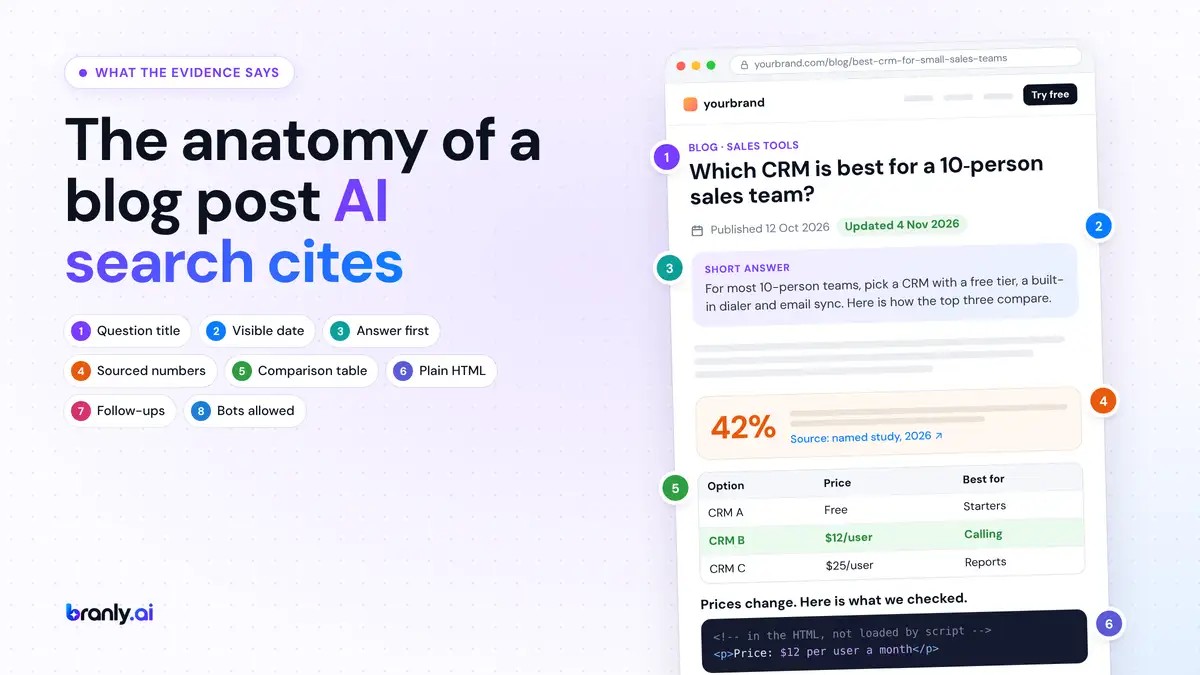
A blog post that AI search cites does eight things. Its title is the buyer's question. It shows a recent date. It answers in the first lines. Every number has a source. Comparisons sit in a table. Key facts are in the page text, not loaded by a script. It answers the next questions a buyer will ask. And it lets the AI crawlers in.
Each part below is backed by a published source, with who published it and what they sell. One thing often sold as essential, special "AI schema", is not needed.
One warning before the list. AI answers cite reviews, news and other third-party sites more than brand blogs. A well-built post is necessary. It is not enough on its own.
The eight parts, and the evidence for each
1. A title that is the buyer's question
Google says the average AI Mode search is "triple the length of a traditional Search query" (Think with Google, May 2026). People ask AI full questions, so the page title should be one.
Ahrefs, which sells SEO tools, studied 1.4 million ChatGPT prompts. Pages ChatGPT cited had titles closer to the prompt than pages it did not cite, with a similarity score of 0.602 against 0.484. That is a correlation, not proof that the title caused the citation.
2. A visible, current date
Google's own guidance: "Add a user-visible date to the page and feature it prominently."
Ahrefs looked at about 17 million cited URLs and found pages cited by AI assistants were 25.7% fresher than pages in organic search results. Google's AI Overviews was the exception: it cited older pages than organic results did.
3. The answer in the first lines
Kevin Indig, a growth advisor, traced 18,012 ChatGPT citations back to the sentences they came from. 44.2% came from the first 30% of the page and 24.7% from the final third (Growth Memo, February 2026, figures as reported by Search Engine Land).
Microsoft Bing says direct questions with clear answers can be lifted "word for word into AI-generated responses". We found no Google statement that says "put the answer first", so this part rests on observed patterns.
4. Every number with its source
A study by researchers from Princeton and IIT Delhi found that adding quotations, statistics and cited sources raised a page's visibility in generative engine answers by up to 40%. Keyword stuffing did not help, and on Perplexity it did about 10% worse. It was accepted at KDD 2024, a major data science conference.
The test ran mostly on a benchmark the researchers built, with a smaller check on Perplexity. We found no study that has repeated it on live ChatGPT or AI Overviews.
5. A table where buyers compare
Microsoft Bing: "Bulleted lists, numbered steps, and comparison tables break complex details into clean, reusable segments." If buyers compare options on price, features or fit, put that comparison in rows and columns.
6. Key facts in plain HTML
In October 2026 Glenn Gabe, an SEO consultant, tested three pages whose content loaded through JavaScript. ChatGPT, Claude and Perplexity failed on all three. Gemini passed all three.
Vercel, which sells web hosting, found in December 2024 that "none of the major AI crawlers currently render JavaScript". Gemini, which uses Google's crawler, was the exception. Microsoft adds that content hidden in tabs or expandable menus may be skipped.
So prices, specs and terms belong in the page text itself. A quick test: open the page source and search for your price.
7. Answers to the follow-up questions
Google says AI Overviews and AI Mode may use "query fan-out", issuing "multiple related searches across subtopics and data sources". A page that answers the next few questions a buyer asks gives those searches more to match.
Keep the answers on the page, not behind clicks. One study from April 2026, of 18,151 pages, found Q&A formatting on its own did not raise a page's influence on AI answers. It was slightly lower. The answers count, not the label.
8. The AI crawlers let in
OpenAI: "Sites that are opted out of OAI-SearchBot will not be shown in ChatGPT search answers, though can still appear as navigational links." Google says a page must be indexed and eligible to show with a snippet to appear in AI Overviews or AI Mode.
Check your robots.txt file and any nosnippet tags. A block set years ago can quietly remove you.
What you do not need
Special "AI schema". Google's documentation says: "There's also no special schema.org structured data that you need to add."
Ahrefs compared 1,885 pages that added schema markup with 4,000 matched pages that did not. AI citations "barely moved": down 4.6% in AI Overviews, and up 2.4% in AI Mode and 2.2% in ChatGPT, both within noise.
We also found no evidence that author bylines or original images raise AI citations. They may help readers. The data does not yet show they help AI answers.
The other side: the best page can still lose to a review site
Researchers at the University of Toronto compared AI search answers with Google's top 10 results on 1,000 "best of" prompts (September 2025). AI answers showed "a systematic and overwhelming bias towards Earned media". Earned media, such as reviews and news, made up 69% to 92% of the sources ChatGPT cited, across three categories in the US and Canada, against 31% to 54% in Google.
Muck Rack, which sells PR software, puts earned media at 84% of AI citations.
So the blog post is one half. Being named on the sites AI trusts, reviews, comparison sites, the press, is the other half.
What this means for brands
- Audit your ten most important buyer-question pages against the eight parts. Start with the plain HTML test. It is the fastest to check and the most often missed.
- Rewrite the first lines of each page to answer the question directly. No intro, no scene-setting.
- Then work on where you are named. Reviews, comparison pages and press coverage carry more AI citations than your own blog.
Most of this is good search practice. Different game, same players.
Questions buyers ask next
Does schema markup help with AI search? Not on the evidence so far. Google says no special markup is needed, and Ahrefs found adding it barely moved AI citations.
Does this work the same for ChatGPT and Google's AI? Not quite. Gemini read script-loaded content in Glenn Gabe's test and ChatGPT did not, though he notes even Gemini missed it on some pages. And in the Ahrefs freshness study, AI Overviews cited older pages than organic results, while the AI assistants cited fresher ones.
How long before changes show up in AI answers? No public study we found measures this. Track your own buyer questions every week and compare.
Sources
- Google, "AI Mode US insights", Think with Google (21 May 2026)
- Ahrefs, "Why ChatGPT cites pages" (15 April 2026)
- Google Search Central, "Publication dates"
- Ahrefs, "Do AI assistants prefer to cite fresh content?" (July 2025, updated April 2026)
- Search Engine Land, on Kevin Indig's ChatGPT citations study (February 2026)
- Microsoft Advertising, "Optimizing your content for inclusion in AI search answers" (8 October 2025)
- Aggarwal and others, "GEO: Generative Engine Optimization", KDD 2024
- Glenn Gabe, "Can AI search platforms render JavaScript?" (19 October 2026)
- Vercel and MERJ, "The rise of the AI crawler" (17 December 2024)
- Google Search Central, "AI features and your website"
- Zhang, He and Yao, study of 18,151 pages (29 April 2026)
- OpenAI, "Overview of OpenAI crawlers"
- Ahrefs, "Schema and AI citations" (11 May 2026)
- Chen, Wang, Chen and Koudas, University of Toronto (10 September 2025)
- Muck Rack study, as published by AI Magazine (7 May 2026)
Date
November 4, 2026