TL;DR
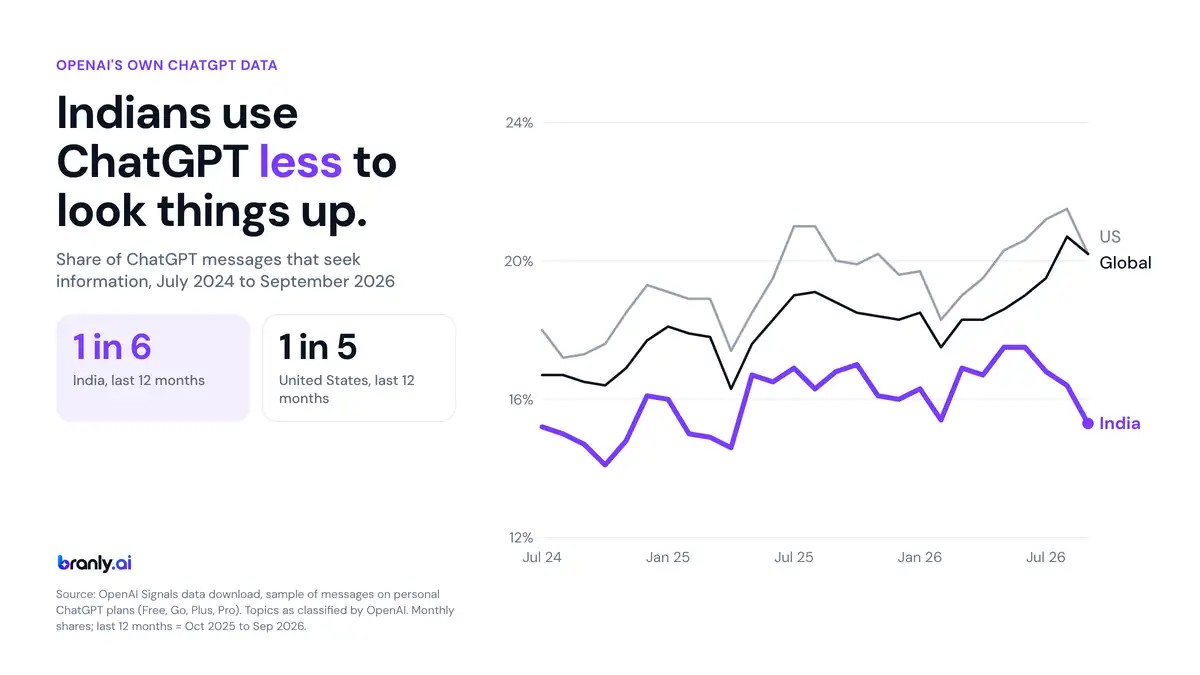
Over the last 12 months, about one in six ChatGPT messages from India was someone looking something up, against one in five in the US, and India sat below the global average in all 27 months of OpenAI's Signals data.
Advice and how-to (Practical guidance) is India's biggest use of ChatGPT, about a third of messages, while Google names India among its biggest markets for AI Overviews and runs AI Mode in Hindi and seven more Indian languages.
For an Indian brand the question is which questions to win where: lookups on Google's AI, advice on ChatGPT, each measured on its own rather than planned from global studies.
What OpenAI's own data shows
OpenAI publishes a sample of how people use ChatGPT, country by country, under the name Signals. The latest release covers messages from July 2024 to September 2026 on personal plans (Free, Go, Plus and Pro). The data can be downloaded and reused under an open licence.
We pulled out India and set it against the United States and the global average.
Over the last 12 months, October 2025 to September 2026, about one in six ChatGPT messages from India was someone looking something up. OpenAI calls this "Seeking information". In the United States the figure was one in five. India sat below the global average in every one of the 27 months in the data.
The single biggest use in India is what OpenAI calls "Practical guidance": how-to advice, tutoring, ideas, and health and fitness questions. It made up about a third of Indian messages over the same 12 months, a little above the global share.
India also ranks 119th of 173 countries on messages sent per person, up from 133rd of 176 at the start of 2025. Per head of population, India still sends fewer messages than most countries.
Why "looking things up" is the number that matters for brands
OpenAI's own research paper on ChatGPT use, published in September 2025, splits "Seeking information" into three parts: specific information, cooking and recipes, and "inquiries about products or services available for purchase". The paper says this category "appears to be a very close substitute for web search".
So the product lookups a brand cares about, which phone, which card, which course, belong to the category where India sits below the global average. Advice and how-to questions sit in the category where India is above it.
The Signals release merges the three parts into one number, so it does not show the product share on its own. What it does show is the shape: in India, ChatGPT is used more as an adviser than as a search box.
The argument this cuts across
For two weeks practitioners have argued about how much AI search matters. On 21 October Marie Haynes, an SEO consultant, shared 12 months of GA4 data from 100 sites: ChatGPT sent 0.62% of the traffic that Google organic sent. Search Engine Roundtable grouped her study with two others, from SEO Works and Kevin Indig, under the headline "3 New Studies Suggest AI Visibility & Search Not Worth Investing In". The other camp says ChatGPT is replacing Google and brands should chase it first.
Neither side was looking at India on its own. None of the three studies reports results by country.
India's own referral numbers are low too. Statcounter data, as reported by the Indian agency upGrowth, put AI chatbots at 0.09% of referrals in India in August 2026, unchanged from a year earlier, against 0.25% globally. The usage mix above may be one reason, though no source links the two.
Where the lookup happens instead
Google has named India, alongside the United States, among its biggest markets for AI Overviews. AI Mode in India now works in Hindi and seven more Indian languages, and Google says India is its largest user base for voice and visual search. In September Google began testing checkout from Flipkart inside Gemini and AI Mode in India, for some users and a small set of products.
Our reading: for an Indian buyer, the AI answer to "which one should I buy" is at least as likely to come from Google's AI as from ChatGPT. That is a reading of the data above, not a measured fact. No public source we found measures it directly.
The other side
First, a share is not a total. Sam Altman wrote in February that India has 100 million weekly ChatGPT users, second only to the United States. One in six messages from that many people is a very large number of lookups.
Second, this is not only an Indian pattern. In September 2026 Indonesia, the Philippines, Nigeria, Pakistan and Brazil all sat between 13% and 16% on looking things up, against about 23% for the United Kingdom and Germany. It may say more about how new a market is than about India. That can change.
Third, OpenAI sorts the messages with its own classifier and publishes about its own product. Earlier versions of Signals have been revised; Search Engine Journal noted that the September 2025 paper put "Seeking information" at 24% of global use by mid-2025, while Signals shows lower figures for the same months.
Fourth, ChatGPT is building a commercial presence in India. Ads went live on the Free and Go plans on 29 August 2026. And a YouGov survey of online searchers in India, run in April and May 2026, found 57% had used AI assistants or chatbots, against 65% who had used search engines in the past 30 days.
What this means for brands
The question is not whether to invest in ChatGPT or Google. It is which questions you want to win, and where those questions are asked.
- Win the lookup questions on Google's AI. "Best X under Y", "X vs Y", "where to buy X". Check whether AI Overviews and AI Mode name you on these, in English and in Hindi, every week.
- Win the advice questions on ChatGPT. "How do I fix X", "what should I do about Y". Pages that teach and explain, with your product as a clear, checkable example, are what an adviser repeats.
- Do not plan India from global averages. The three studies behind this month's debate did not report India separately. Measure your own buyers' questions on each engine, separately.
Different game, same players. The difference in India is which engine is asked which question.
Sources
- OpenAI, "Signals individual data"
- OpenAI, "Signals data download and methodology"
- OpenAI, "How People Use ChatGPT" (Chatterji, Cunningham, Deming and others, September 2025)
- Search Engine Journal, "ChatGPT Signals: consumer messages and information seeking" (27 October 2026)
- Search Engine Roundtable, "3 New Studies Suggest AI Visibility & Search Not Worth Investing In" (22 October 2026)
- Marie Haynes on X (21 October 2026)
- upGrowth, "AI traffic share report 2026" (Statcounter data)
- Google India blog, "Introducing AI Mode in India" (24 June 2025)
- Google India blog, "New languages in AI Mode, Search Live debuts" (8 October 2025)
- TechCrunch, "Google tests buying from Flipkart through Gemini and AI Mode in India" (26 September 2026)
- Storyboard18, "India now has 100 million weekly ChatGPT users, says Sam Altman" (16 February 2026)
- PPC Land, "OpenAI gains 32 ChatGPT ad markets in 5 days as India goes live"
- Business Today, "AI assistants close in on search engines as India's online discovery habits shift: YouGov" (10 July 2026)
Date
November 3, 2026