TL;DR
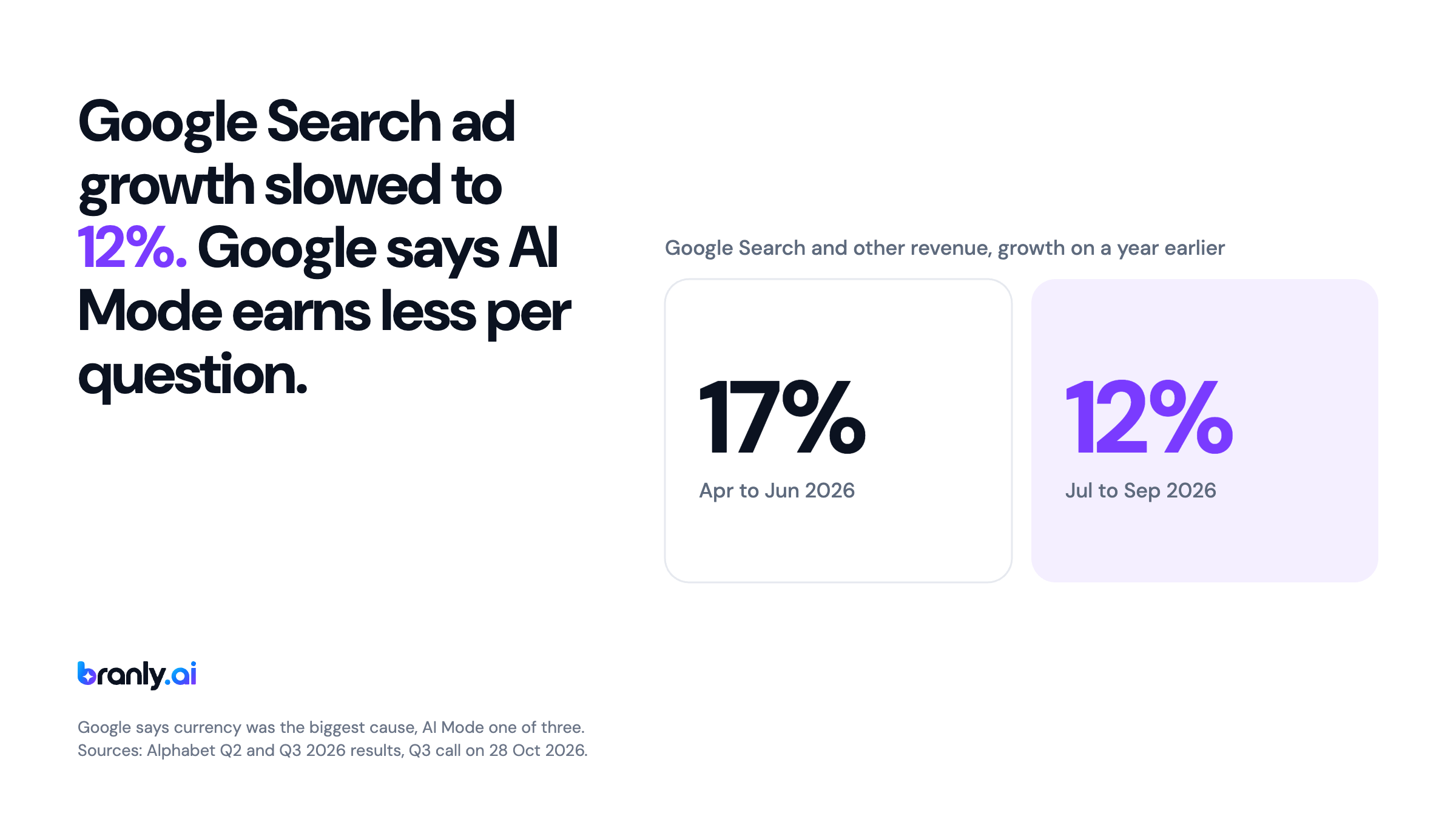
Google Search and other revenue grew 12% year on year to $63.35 billion in Q3 2026, down from 17% growth in Q2, and Philipp Schindler named lower monetization in AI Mode as one of three causes, after currency.
On the same day Google began scaling ads in AI Mode in India and nine other countries, with Brazil, Mexico and the UK planned for Q4 2026 and follow-up-question ads in the US.
Google's own help page says paid ads do not influence the organic AI answer, so the unpaid mention in the answer is what brands are left to earn.
What happened
On 28 October 2026 Alphabet reported its third quarter. Google Search and other revenue came in at $63.35 billion, up 12% from a year earlier. In the second quarter the same line had grown 17%.
On the call that evening, JPMorgan analyst Doug Anmuth asked why Search had slowed. Philipp Schindler, Google's chief business officer, named three causes. Currency came first. He called it "the single largest driver of Search deceleration relative to Q2". Then came spending patterns in retail and in media and entertainment. Then AI Mode: "the strong growth in AI Mode queries had an impact because of the lower monetization we were seeing in AI Mode."
That is Google saying, in its own words, that a question asked in AI Mode earns less than a classic search.
The same day, Google's ads team published a post saying it is now scaling ads in AI Mode in ten countries: Australia, Canada, India, Kenya, Malaysia, New Zealand, Nigeria, Pakistan, the Philippines and Singapore. Brazil, Mexico and the United Kingdom are planned for the fourth quarter of 2026. In the United States, Google is adding what it calls multiturn ads, which appear in answers to follow-up questions inside a conversation.
Google's answer to lower earnings is more ads, not fewer
Google is not stepping back from AI Mode because it earns less. It is doing the opposite. On the call Schindler said the majority of AI Mode queries are incremental, that many are upper-funnel, and that this creates "more monetization opportunities over time". He said Google is "now scaling high-quality ads within AI Overviews and AI Mode to more users and queries".
The gap Google described reads as a gap per query. Sundar Pichai said on the same call that queries in AI Mode are on average three times longer than traditional searches, and that one in five AI Mode searches globally use voice, images or documents. A long, conversational question gets one written answer and fewer ad slots on the screen. Ads in the follow-up turns of a conversation are the fix Google has chosen.
The market did not take it calmly. Alphabet shares fell more than 12% the next morning, and Bloomberg put the loss at $511 billion in market value, as reported by The Next Web. Analysts split. Gil Luria of D.A. Davidson said investors would worry that "AI has finally come for Google", though he would not rush to conclusions from one quarter. Scott Devitt of Rosenblatt Securities said he did not see a sea change.
India got AI Mode first, and now it gets the ads
AI Mode opened in Search Labs in India on 23 June 2025, in English. Two weeks later, in the first week of July 2025, it went to all users in India, the first market outside the US to get it. Hindi followed in September 2025. Google has described the US and India as "our biggest markets" when talking about AI Overviews.
Now India is in the first wave of ads. According to Google's own Ads help page, ads within AI Overviews and AI Mode are available in English in the United States and select English-speaking markets, and India is on that list. As written, the ads run in English.
For an Indian advertiser there is nothing to switch on. The help page says existing Search, Shopping and Performance Max campaigns "automatically participate through the Google Ads auction when relevant". You cannot opt out of AI Mode placements separately from Search. Performance metrics for these ads are included in aggregate in standard campaign reports, so there is no separate line that tells you what AI Mode did for you.
The other side
First, currency, not AI Mode, was the biggest cause of the slowdown. Schindler said so plainly. Anat Ashkenazi, the chief financial officer, added that Google is now lapping the acceleration in Search that began in the third quarter of 2025, and that this will pressure growth in the fourth quarter too. This quarter is not proof that AI Mode is eating Search revenue. It is Google saying yield is lower today and that it expects to close the gap.
Second, Google says the ads work. Both Schindler and the ads blog state that click-through rates are already similar between sponsored and organic product list items within AI Mode. That is Google's own measurement and no figure was published. Barry Schwartz of Search Engine Roundtable pointed out that product results are highly graphical and asked what happens with plain text links.
Third, there is history here. In spring 2025 Google said ads shown with AI Overviews earned the same as ads without them. Schindler told the first quarter 2025 call that Google saw "monetization at the same rate", and Sundar Pichai called it "the baseline" in a May 2025 interview. That claim covered AI Overviews only. AI Mode is a different product, and this week Google said something different about it.
One more thing worth watching. On 29 October 2026 Search Engine Roundtable reported screenshots of an AI Mode carousel carrying two headers, "Sponsored" and "All products". A Google spokesperson confirmed the test and said Shopping ads can appear alongside organic visual results within carousels for commercially relevant queries. Google has mixed ads into organic product results in classic Search since 2023. It is now trying the same inside the AI answer.
What this means for brands
The paid slot in Google's AI answer is now a fact in India. The unpaid part of the answer is what is left to earn.
Google's help page says: "Paid advertising does not influence the organic responses generated by Google AI." Read that both ways. Your ad budget does not buy you a mention in the answer text, and a rival's budget does not take yours away. The answer is earned on a different basis from the ad.
Three things worth doing now.
- Check whether AI Mode names your brand on your buyers' questions, in English and in Hindi, and do it this week, before the ad carousels take up more of the screen. One day's result is noise. Run the same questions every week and watch the trend.
- Know that your ads are already in AI Mode. If you run Search, Shopping or Performance Max campaigns in India, they are eligible there. Look in your search terms report for longer, conversational queries that were not there before. Negative keywords and brand exclusions are the only controls Google gives you over where these ads serve.
- Treat the answer text and the ad carousel as two surfaces with two jobs. One is paid and auctioned every day. The other is earned over weeks and depends on the pages, mentions and sources the AI reads. Budget and staff them separately.
Sources
- Alphabet, "Alphabet Announces Third Quarter 2026 Results"
- Alphabet, "Alphabet Announces Second Quarter 2026 Results"
- The Motley Fool, "Alphabet (GOOGL) Q3 2026 Earnings Call Transcript"
- Google Ads and Commerce blog, "Ads in AI Mode expand to new markets"
- Google Ads Help, "About ads in AI-powered experiences in Google Search"
- Search Engine Roundtable, "Google: Ads In AI Mode Earning Less Than Traditional Search Ads"
- Search Engine Roundtable, "Google Expands Ads In AI Mode To More Countries & Multiturn Ads In U.S."
- Search Engine Roundtable, "Google AI Mode Tests Blending All Products With Sponsored Products"
- Search Engine Roundtable, "Google's Pichai: Search Ads With AI Overviews Earn Same As Ads Without"
- The Next Web, "Alphabet shares fall 12% after Google says AI Mode searches earn less"
- 9to5Google, "Google launches AI Mode in India as first international expansion"
- Storyboard18, "AI Mode: Google expands AI-powered search feature to all users in India"
- Google India blog, "Google Search: AI Mode now in Hindi"
- Search Engine Land, "Google AI Mode now available in India"
Date
November 1, 2026