TL;DR
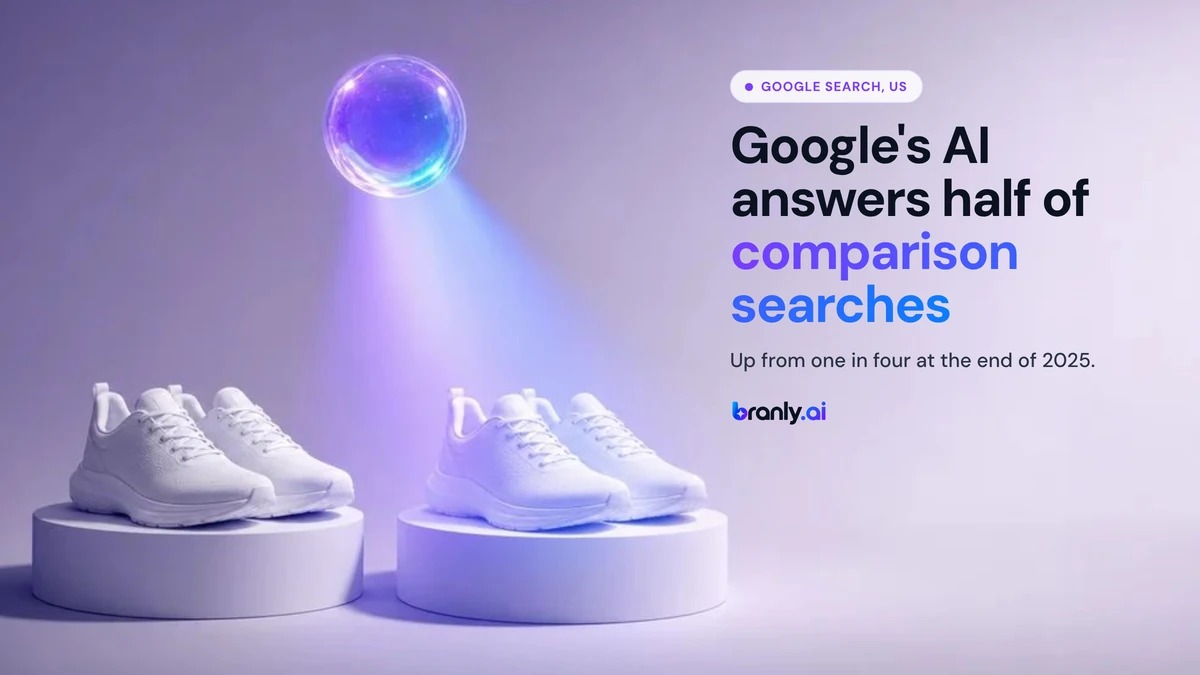
DataForSEO's US data shows AI Overviews on 51% of commercial searches in Q3 2026, up from 26% at the end of 2025, with most of the jump in one quarter.
When an AI Overview appears on these searches, the links inside it take an estimated 42% of clicks and the top organic result gets 21%, against 34% without one.
The click figures are modeled estimates and US only, and Google said in 2025 that total clicks to websites were roughly stable, so check whether AI names you on buyer comparison questions.
Half of US comparison searches on Google now show an AI answer
Many brands still think of Google's AI Overviews as a feature for simple questions. How long to boil an egg. What a word means. The new data says otherwise.
DataForSEO, which sells search and AI data to SEO tools, tracked millions of US Google results pages every quarter. It looked at commercial searches, the ones people make while comparing options before they buy, such as "best CRM for small teams" or one brand against another. In the last quarter of 2025, 26% of these searches showed an AI Overview. By the third quarter of 2026, it was 51%.
So on US Google, about one in two comparison searches now shows an AI answer. At the end of 2025, it was about one in four.
The jump came fast, and mostly in one quarter
The rise was not steady. Commercial searches with an AI Overview went from 26% to 29% to 33% over the first three quarters the report covers. Then they jumped to 51% in the third quarter of 2026, a quarter the report only covers up to 14 September.
The other kinds of search moved the same way:
| Kind of search | End of 2025 | Q3 2026 |
|---|---|---|
| Informational (learning about something) | 48% | 70% |
| Commercial (comparing options) | 26% | 51% |
| Navigational (looking for a site) | 17% | 34% |
| Transactional (ready to buy) | 11% | 29% |
The commercial row is the one that matters most to a brand. These are the searches where a buyer is still deciding.
A second study points the same way
Semrush, which sells SEO tools, ran a separate check. It followed 400 commercial keywords in banking, ecommerce and software on US desktop searches, with words like "best", "reviews", "alternatives", "price" and "versus".
In September 2025, 45.75% of those keywords showed an AI Overview. In August 2026, 88% did. Searches with "reviews" in them showed an AI Overview less than a third of the time a year ago, and nearly 90% of the time now.
Two companies, two different sets of keywords, the same direction. That makes the trend hard to wave away, even if the exact level differs.
Where the clicks go when the AI answer appears
DataForSEO also estimated how clicks split on a results page, with and without an AI Overview. It used a snapshot of US searches from 7 September 2026 and click estimates built from clickstream data. Searches where nobody clicked are left out.
On commercial searches without an AI Overview, the top organic result got an estimated 34% of the clicks. On commercial searches with one, the links inside the AI answer took an estimated 42% of the clicks, and the top organic result fell to 21%.
The same pattern held for every kind of search. The links inside the AI answer took between 42% and 45% of the estimated clicks each time.
That changes what winning means. Ranking first still counts. But when the AI answer shows up, the largest single block of estimated clicks, about twice what the top result gets, goes to the pages the AI chose to cite.
The other side
There are good reasons to weigh these numbers with care.
First, the click figures are estimates from a model, not counted clicks. The report says so plainly. And on a separate measure, the fall in click rates for top results over the year, it says it cannot tell whether AI answers, page layout changes or user habits explain it.
Second, Google disagrees with the gloomy reading. In August 2025, Liz Reid, who heads Google Search, wrote that "total organic click volume from Google Search to websites has been relatively stable year-over-year", and that Google is sending "slightly more quality clicks" than a year earlier. Google did not publish the data behind this, and the statement is older than the period in the new report.
Third, the transactional figure rests on a small sample, about 59,000 searches in the last quarter against 5.6 million commercial ones. And an earlier Semrush study, covering November 2025 to April 2026, found that the share of transactional results with an AI Overview fell by about 5%. The commercial trend has more support than the transactional one.
Fourth, the report's search and AI answer data cover only the US, in English. None of it is from India.
What about India
No study we found measures how often AI Overviews show up on Indian comparison searches. What we do know is how Indian searchers behave. A YouGov survey of more than 950 online searchers in India, run in April and May 2026, found that 57% use AI assistants or chatbots, close behind the 65% who used a search engine in the past 30 days.
Indian online searchers already use AI assistants. If the US pattern on Google reaches India, comparison searches here will follow.
What this means for brands
- List the comparison questions your buyers ask. "Best X for Y", your brand against a rival, "X reviews", "alternatives to X". These are the searches where AI answers now appear most often for buyers who have not decided yet.
- Look at the AI answer, not only your rank. For each question, check whether the AI answer shows up, whether it names you, and which pages it cites. If it cites a review site or a comparison page, that page is where many of your buyers' clicks now go.
- Work on being one of the cited pages. That means pages that answer the comparison directly, and being named on the review and comparison sites the AI already trusts.
This is what Branly checks: for the questions your buyers ask, whether AI names your brand, and which sources it relies on. Different game, same players.
Sources
- DataForSEO, "Search Insider 2026" (29 October 2026, free with a sign-up form)
- Semrush, "AI Overviews have nearly doubled across five commercial search modifiers" (21 October 2026)
- Semrush, "AI Overviews are expanding across commercial intent search" (2 July 2026)
- Google, Liz Reid, "AI in Search is driving more queries and higher quality clicks" (6 August 2025)
- Business Today, on YouGov's India Web Search and AI Report 2026 (10 July 2026)
Date
November 6, 2026