TL;DR
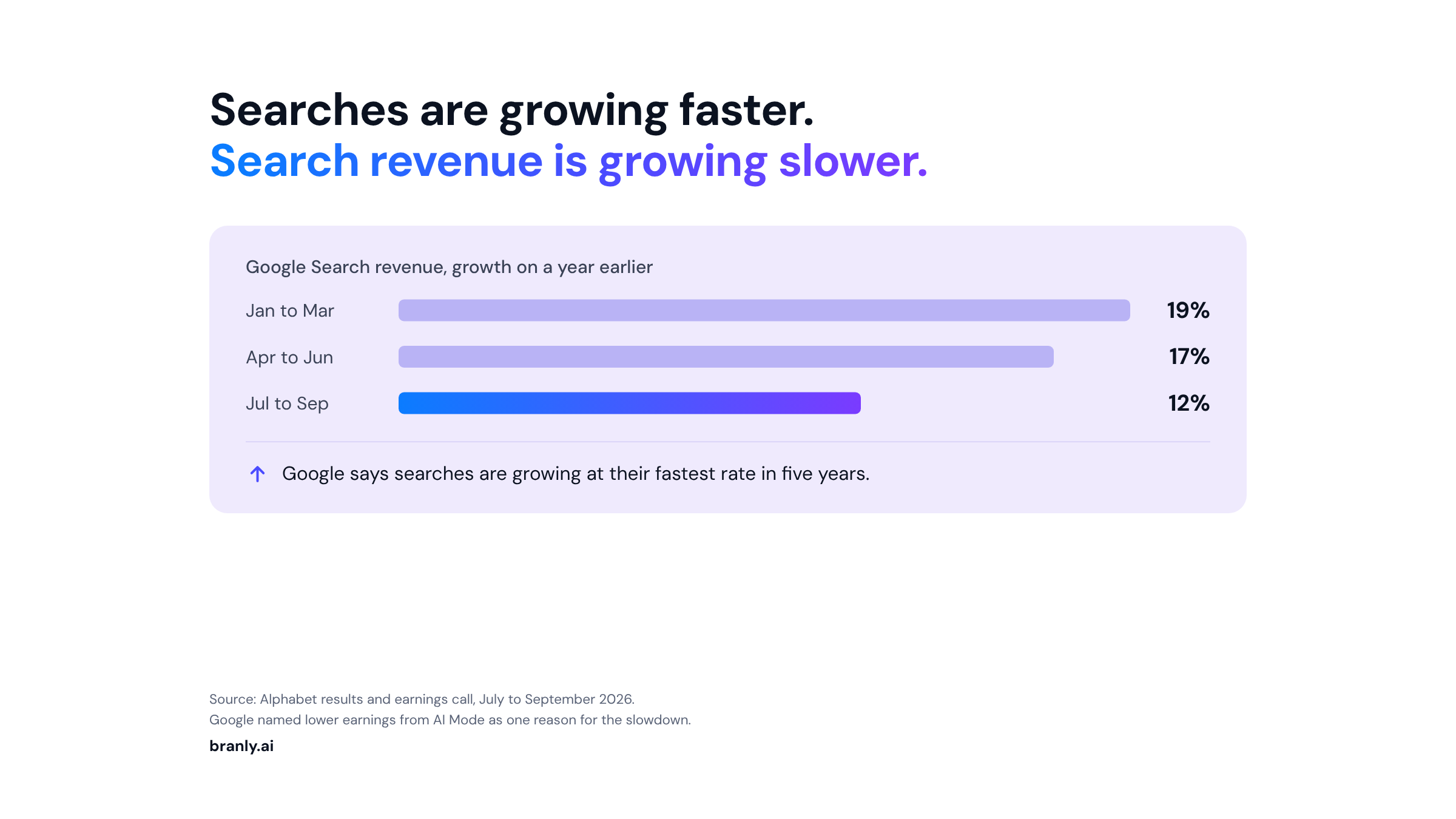
Google's Search revenue grew 12% in July to September 2026, down from 19% and 17% earlier this year. It did not fall.
Google says searches are growing at their fastest rate in five years, yet Search revenue barely moved from the quarter before.
Google named lower earnings from AI Mode as one of the reasons. More of the buying journey now happens inside an AI answer.
What happened
Alphabet, Google's parent company, shared its results for July to September 2026. On the next trading day, 29 October, its share price fell 12.6%. It was the company's biggest one-day fall since it listed in 2004. News reports put the value lost at between $475 billion and $500 billion.
The overall numbers were not bad. Total revenue grew 25% to $127.6 billion. Google Cloud more than doubled. But revenue and profit both came in below what analysts expected, and investors focused on one line: Search.
Search did not shrink. It slowed.
Search is still Google's biggest business. In the quarter it earned $63.4 billion, 12% more than a year earlier.
The problem is the direction. Search grew 19% in January to March and 17% in April to June. Now it is 12%. Compared with April to June, Search revenue hardly moved: $63.3 billion then, $63.4 billion now. CNBC reported that Search came in below analysts' forecasts for the second quarter in a row.
People are searching more than ever
This is the part that matters. Sundar Pichai, Google's CEO, said the number of searches is growing at its fastest rate in five years. He also said questions asked in AI Mode, Google's chat-style search, are on average three times longer than normal searches.
So searches are growing faster, while Search revenue is growing slower. Google has not said how much it earns per search. But as the next section shows, it did say that searches in AI Mode earn less than normal ones.
Google's own explanation
Google's executives gave four reasons. Only one of them is about AI.
- Exchange rates. Currency movements reduced the value of sales made outside the US. Google called this the biggest cause of the slowdown compared with April to June.
- A tough comparison. Search grew unusually fast in the second half of 2025, so this year is measured against a high bar. Anat Ashkenazi, the CFO, said this will also hold back growth in October to December.
- Some advertisers spent less. Some retailers in Asia cut back after the EU ended a duty exemption on low-value imports. Media spending also came down after the FIFA World Cup lifted it in April to June.
- AI Mode earns less. Philipp Schindler, Google's Chief Business Officer, said "the strong growth in AI Mode queries had an impact because of the lower monetization we were seeing in AI Mode."
That last point is the one to note. Google has now said, on its own earnings call, that people moving to its AI answers is costing it Search revenue, at least for now.
Google expects this to change. It is adding ads to AI Overviews and AI Mode for more people and more questions. It says most AI Mode questions are new questions, ones people did not ask before. It also says people click sponsored products in AI Mode about as often as they click the unpaid ones next to them.
What analysts read into it
Analysts were less patient. UBS said the results bring "Search cannibalization fears right back to the forefront". That is the worry that Google's own AI answers eat into its ad business. Gil Luria of D.A. Davidson said investors will worry that "AI has finally come for Google."
These are opinions. Exchange rates and last year's fast growth explain part of the slowdown. But AI answers are now part of Google's own explanation, not just an analyst's guess.
What this means for brands
Google is changing how Search makes money because people are changing how they search. They ask longer questions. They read an AI answer. Often they decide from that answer without opening a list of links.
For a brand, this moves the place where buyers form a view. When a buyer asks AI Mode, ChatGPT or Gemini which product to choose, the answer names a few brands. The players are the same as in search. The game is different: the answer itself, the sources it draws on, and how you measure whether you are in it.
Three things are worth doing now:
- Know the questions your buyers ask AI. Start with the ten questions that come up most on your sales calls.
- Check whether AI names you. Ask those questions in ChatGPT, Gemini and Google's AI Mode. Note who gets named, and which websites the answer quotes.
- Track it every week. AI answers change often. One check tells you little. A weekly view shows whether you are gaining or losing ground.
Google will find ways to put more ads into AI answers. It said so. But the answer itself also names brands, and that part is not paid for.
Sources
- Alphabet, Q3 2026 earnings release
- Alphabet Q3 2026 earnings call transcript, The Motley Fool
- Search Engine Journal, "Google Says Lower AI Mode Monetization Weighed On Search Growth"
- CNBC, "Alphabet tanks nearly 13% for worst day ever, losing $500 billion in value"
- CNBC, "Alphabet earnings miss reflects first real sign that AI is taking a bite out of search"
- Stocktitan, "Alphabet Q3 2026 earnings"
- Yahoo Finance, "Alphabet loses $475 billion in market value, the biggest drop in its history"
Date
October 31, 2026